Summary
Editor's rating
Value: worth it for racers, overkill for holiday skiers
Design: race look, race stance, not much compromise
Comfort: tight, cold at first, better once broken in
Materials: sturdy shell, basic liner, built to take a beating
Durability: built for a few hard seasons of junior abuse
Performance: where the boot finally makes sense
What you actually get with the Hero World Cup 90 SC
Pros
- Strong, precise support for light but advanced junior skiers
- Durable shell and hardware that can handle heavy use and likely a second owner
- Race-oriented fit and stance that works well in gates and on hard pistes
Cons
- Tight and cold at first, with a noticeable break-in period
- Overkill and not very comfortable for occasional or casual junior skiers

Specifications
View full product page →| Brand | Rossignol |
Race boots for kids who actually charge
I’ve spent a good chunk of this season helping a junior racer (UK size 3 feet) test the Rossignol Hero World Cup 90 SC Junior Alpine Ski Boots in grey. These aren’t rental-shop toys; they’re clearly built for kids who are already doing gates, training regularly, and need something closer to a real race boot. If you’re thinking about these for casual holiday skiing, you might want to read this carefully first.
Over about six weekends and one full training camp week, we used these boots in mixed conditions: early-morning ice, chopped-up afternoon snow, and a couple of wet slush days. So this isn’t just a “tried them for one day on perfect groomers” kind of review. We had time to see how they feel, how they pack out, and how annoying (or not) they are to live with in real life: walking to the car, getting them on at 7am, that sort of thing.
The short version: they’re pretty solid performance boots for strong junior skiers, with a clear focus on control and precision more than comfort. They feel closer to an adult race boot than to a junior recreational boot. That’s good if your kid is pushing hard and needs that support; less good if they mostly want warm, forgiving boots for cruising blues with the family.
They’re not perfect. There are some comfort quirks, a bit of a battle to get them on when it’s cold, and you definitely pay a premium for the race badge and the Rossignol name. But if you know what you’re getting into and your kid is already complaining that their current boots feel too soft or sloppy, these are worth a serious look.
Value: worth it for racers, overkill for holiday skiers
On the money side, these Rossignol Hero World Cup 90 SC boots are not cheap, especially for a junior product that kids will eventually outgrow. You’re paying for the race label and the stiffer construction. Compared to more recreational junior boots from mid-range brands, you’re likely spending noticeably more for something that looks and feels more serious. The question is whether your kid will actually use what you’re paying for.
If your child is in a race club, skis many days a season, and is already pushing against the limits of a softer boot, the value makes sense. You’re buying a tool that can genuinely help them ski better and more precisely. In that context, spending extra for a proper performance boot is reasonable. You also get good durability, so you can probably resell them or pass them down once they’re too small. That spreads the cost a bit.
On the other hand, if your kid skis one or two weeks a year on family holidays, I’d say these are overkill. They’ll complain about the stiffness and the cold, and they won’t really benefit from the extra precision because they’re not skiing hard enough or often enough. A softer, cheaper junior boot would be more comfortable and more than enough for cruising blues and reds. You’d just be paying extra here for the race look and the brand name.
So in terms of value, I’d call it “good but specific.” For the right kid (light but strong, technically focused, training regularly), the price is justified because the boot actually brings something to their skiing. For a casual junior skier, your money is better spent elsewhere, either on more ski days or on a cheaper, more comfortable boot. It really depends on how serious your young skier is.
Design: race look, race stance, not much compromise
Design-wise, Rossignol kept it pretty straightforward. The boots are mainly grey with some race-style graphics, so they look serious without screaming for attention. My tester actually liked that it didn’t look like a toy or a kid’s rental boot. It sits visually in the same family as the adult Hero race boots, just scaled down. If your kid is into the whole race-team vibe, they’ll probably like the look. If you want something bright and flashy, this isn’t it.
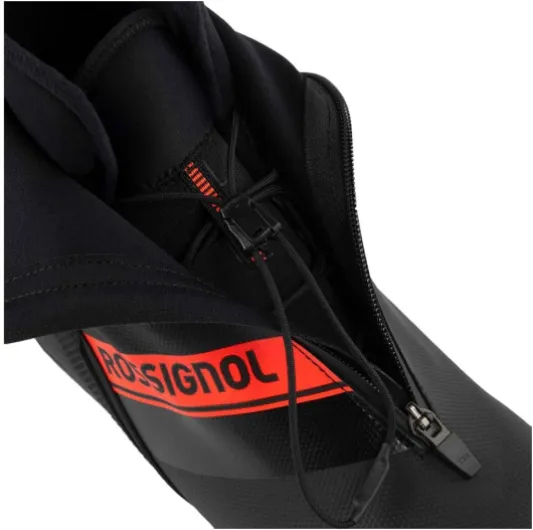
The stance and shape are clearly built for performance. The cuff is quite upright but with a race-style forward lean once you’re clipped into skis. There’s not a ton of room to move around; your shin sits pretty locked in once you crank the buckles. The 4-buckle layout plus power strap is standard race boot stuff: no gimmicks, just solid hardware. The buckles have enough micro-adjustment to dial things in, but they’re quite stiff to close, especially in the cold. My 12-year-old could close the top buckles but needed a bit of body weight to do it properly.
One thing I noticed is the low-volume fit around the ankle and heel. The boot really tries to pin the heel down, which is great for edge control but can feel a bit brutal when you’re trying to slide your foot in. After a few days, the liner eased up slightly, but the basic design stays snug. There’s not much extra padding or space. If your kid has wide feet or a high instep, plan on a bootfitter visit or just look at a different model.
In practice, the design is very clear: this is a boot meant for going fast and holding an edge, not for strolling around the resort. Walking in them is clumsy and noisy, and the sole isn’t particularly grippy. We had a couple of minor slips on icy car parks. Nothing dramatic, but you do feel that the design priority is skiing performance, not comfort or convenience off the snow.
Comfort: tight, cold at first, better once broken in
Let’s be blunt: out of the box, comfort is not the strong point of these boots. The first two days, my tester described them as “pretty painful” around the instep and ankle bones. We had to play with buckle tension a lot: keeping the lower buckles one notch looser during warm-up runs, then tightening them for training. If you’re used to softer, rental-style junior boots, this will feel like a big step up in tightness and overall pressure.
After about 4–5 full ski days, the liner started to shape a bit. The pressure points reduced, especially around the heel, and the boots became bearable for full training days (4–5 hours on snow with breaks). Still, they never turned into slippers. My tester could wear them from first lift to lunch without complaining too much, but always wanted them off during longer breaks. Toes stayed on the cold side in sub-zero temperatures, even with decent socks. We ended up adding a thin extra insole and being very careful about sock choice, which helped a bit.
One thing to note: getting them on and off is a workout. Morning routine usually involved warming the boots up in the car or lodge, fully opening all buckles and the power strap, and then really pulling the tongue forward to slide the foot in. On very cold mornings, I had to help by holding the shell open. Kids with less patience will probably get frustrated. Once on, walking to the lifts isn’t pleasant; the stiff shell and non-rockered sole make every step feel clunky.
So overall, comfort is acceptable for a race-style boot, but definitely not cosy. If your kid is already used to tighter boots and cares more about control than warmth, these will be fine after a break-in period. If they’re coming from soft, warm rentals and complain easily about foot pain, I’d think twice or budget for a proper bootfitting session to punch out hotspots and maybe add custom footbeds.
Materials: sturdy shell, basic liner, built to take a beating
The shell material feels solid and quite rigid for a junior boot. Rossignol doesn’t plaster the exact plastic mix all over the boot, but judging by feel and how it behaves in the cold, it’s a pretty hard plastic that doesn’t soften much with temperature. On very cold mornings, the shell is a bit of a nightmare to open up for getting the foot in. You really have to pull on the tongue and pry the cuff apart. On warmer days it’s easier, but it’s still not a casual slip-on boot.
The liner is on the thinner and firmer side. Don’t expect thick, fluffy padding. Around the heel and ankle there’s a decent amount of dense foam that keeps the foot locked in, but the toe box is fairly minimal. My tester complained about cold toes on the first two icy mornings, even with proper ski socks. After a few days, the liner packed slightly and circulation improved, but it never became what I’d call warm. It’s functional and supportive, but pretty basic in terms of comfort materials.
The buckles are metal and feel tough. Over several weeks of opening and closing them in cold conditions, we didn’t see any bending or weird play. The power strap is standard Velcro, nothing fancy, but it holds well and doesn’t slip. The soles are non-grip alpine soles, so they’re compatible with standard alpine bindings, but again, no rubber or walk-friendly stuff. These materials are clearly chosen for race performance and durability on snow, not for hiking around.
Overall, the materials give a clear impression: this boot is built to last a few seasons of training and racing for one kid, then probably move on to a younger sibling. It’s not luxurious, but it feels tough. If you’re expecting high-tech liners or fancy cushioning, you’ll be disappointed. If you want something that can handle repeated days in gates and being thrown in and out of the car, it feels up to the task.
Durability: built for a few hard seasons of junior abuse
Over the weeks we used them, the Hero World Cup 90 SC boots held up well. The shell barely shows any wear beyond the usual cosmetic scuffs from lift queues and walking on rough ground. No cracks, no weird discoloration, and the flex feels the same now as on day one. Junior race kids are not gentle with their gear – they kick them off, drag them around, and bash them together in lift lines – and the boots handled that without any real drama.
The buckles still feel tight and precise. None of them bent or loosened, even though my tester tends to over-tighten everything. The micro-adjustment screws stayed in place, which isn’t always the case with cheaper boots. The power strap Velcro is still grabbing properly. After multiple days of snow, slush, and being dried in a basic boot dryer, there’s no sign of stitching coming apart on the liners.
Inside, the liner foam has packed out a bit, but not to the point of feeling sloppy. It actually improved the comfort slightly without ruining the snug performance fit. I don’t see these liners suddenly collapsing after one season. Realistically, most kids in this size are going to outgrow the boots before they actually wear them out. The only weak point I can see long term is the usual one: the soles will get chewed up if your kid walks a lot on concrete or rocks, since there’s no grippy rubber section.
For the price bracket and the target user, I’d say durability is pretty solid. If you plan to pass them down to a younger sibling, that looks realistic as long as you don’t let your kid abuse them off snow too much. They feel like they can handle two junior owners in a row without turning into mush, which is more than I can say for some softer, cheaper junior boots we’ve had.
Performance: where the boot finally makes sense
On snow, the whole point of the Hero World Cup 90 SC becomes obvious. The 90 flex, for a light junior, feels firm but not unmanageable. My tester is around 45 kg and could flex them properly after a few runs to get used to them. Compared to his previous 70 flex boots, there was a clear jump in precision. When he tipped the skis on edge, the reaction was quicker and more direct. On hard morning ice, the boots held the line much better, and he had less of that “lag” feeling between what his legs were doing and what the skis were doing.
In gates, the difference was noticeable. Turn entries felt cleaner, and there was more support in the back seat. When he got thrown off balance, the stiffer cuff helped him recover instead of folding. He mentioned feeling more confident at higher speeds because the boots didn’t wobble or twist as much. For slalom-style turns, the quick response was a real plus. For free skiing on bumpy slopes, it was a bit more tiring; the boot doesn’t absorb much, so the legs have to work.
One trade-off: in soft, chopped-up afternoon snow, the stiffness can feel harsh. The boot doesn’t really soften up, so if your kid likes to mess around, jump off side hits, or ski all over the place, it can feel a bit overkill. It’s clearly tuned for firm pistes and gate training, not for playful all-mountain days. Also, if the skier is too light or not aggressive enough, they might struggle to bend the boot and end up in the back seat.
Overall, from a performance angle, these boots do their job well. They give good edge hold, strong support, and a very direct feel. If your kid is in a race club or pushing their technique, they’ll probably feel the benefit. If they’re casual skiers, that extra performance will mostly turn into extra fatigue and complaints about stiffness.
What you actually get with the Hero World Cup 90 SC
The official name is Rossignol Hero World Cup 90 SC Junior Alpine Ski Boots, model number Hero World Cup 90 SC, manufacturer reference RBN9050, colour grey, UK size 3 in our case. So on paper, this is a 90 flex junior race-style boot with a short cuff (that’s what the SC usually stands for: short cuff), aimed at lighter skiers who still want a stiff, reactive boot. It’s not some mystery product; it fits right into Rossignol’s race line, just shrunk down.
In the box you get the boots, a very thin instruction leaflet, and that’s about it. No fancy extras, no extra footbeds, no extra spoilers. It’s very bare-bones, which is fairly normal for race-oriented gear. Everything is focused on the shell and the liner doing their job. The ASIN for the product is B0FWRHPV57, which doesn’t matter much in real life, but at least it makes it easy to track the exact model if you’re comparing online.
On first contact, they feel like serious hardware: heavy for a junior boot, quite rigid in the shell when you try to flex them by hand, and pretty narrow inside. Compared to more recreational junior boots from brands like Salomon or Atomic, these feel tighter and more aggressive right away. My tester, who was coming from a softer 70 flex junior boot, immediately noticed the difference just flexing them indoors.
So, in terms of presentation, what you’re buying is clear: a compact, stiff-ish boot for a small but strong skier who is already used to proper ski boots. If you’re expecting something plush, warm, and super forgiving, this isn’t that. If you want a boot that feels closer to what you see on race kids in clubs, this lines up with that expectation pretty well.
Pros
- Strong, precise support for light but advanced junior skiers
- Durable shell and hardware that can handle heavy use and likely a second owner
- Race-oriented fit and stance that works well in gates and on hard pistes
Cons
- Tight and cold at first, with a noticeable break-in period
- Overkill and not very comfortable for occasional or casual junior skiers
Conclusion
Editor's rating
The Rossignol Hero World Cup 90 SC Junior Alpine Ski Boots in UK size 3 are clearly aimed at a specific type of young skier: light but committed, probably in a race club, and already used to tighter, firmer boots. They offer strong support, a precise feel, and solid durability. On hard snow and in gates, they do what they’re supposed to do: they give quick response and help keep the skier stable at higher speeds. In that context, they make sense and feel like a proper step up from softer junior boots.
They’re not without downsides. Comfort out of the box is rough, especially around the instep and toes, and warmth is just okay at best. Getting them on and off is a bit of a fight, and walking in them is clumsy. For kids who only ski a little or who are sensitive to foot pain, these will probably feel like too much boot. You’re also paying a decent amount of money for something your kid will eventually outgrow, so it’s only really worth it if they ski a lot and make use of the performance.
If your child is a serious junior skier who complains that their current boots feel too soft or imprecise, and you’re ready to deal with a break-in period and maybe a bootfitter visit, these are a good option. If you’re just looking for comfortable boots for family holidays, I’d skip them and look at softer, warmer models instead.