Summary
Analysis score
Average of the criteria rated below
Value for money: who should pay for this level of shoe
Sporty look and low-top profile for everyday wear
Comfort and support: what parents report
Mesh, synthetic upper and rubber sole: built like a real runner
Durability and daily use potential
Running performance and support for active kids
What the GT-1000 11 GS actually offers
Pros
- Maximum cushioning with GEL heel and FlyteFoam midsole for impact protection
- DuoMax support system offers real stability help for kids who overpronate
- Machine washable synthetic/mesh construction and rubber outsole suited to active daily use
Cons
- Not water resistant, limiting use in wet or winter conditions
- Support and price level may be unnecessary for kids with very light or occasional activity

Specifications
View full product page →| Brand | ASICS |
Stable kids’ runners with real support, not just fashion trainers
The ASICS GT-1000 11 GS is clearly aimed at kids who actually run, not just walk around the playground. It’s a unisex model in size 6 UK here, with a bright Island Blue/Black colourway and a spec sheet that looks very close to an adult stability running shoe. You get GEL in the heel, FlyteFoam in the midsole, and the DuoMax support system, which is usually reserved for mild overpronation control in adult shoes. In other words, this is not a basic canvas trainer with a logo slapped on it.
The customer feedback is currently very small in volume but very positive: a 5.0/5 average from 3 ratings on Amazon. That’s not enough to draw big statistical conclusions, but it does show that the first buyers are satisfied. Comments point towards a good fit and overall comfort, which matches what you’d expect from a shoe with maximum cushioning and a running-oriented design.
On paper, the GT-1000 11 GS is built for kids who do sports: running, school athletics, or just a lot of daily walking. The rubber sole, cushioned foam insole with GEL, and low-top profile suggest a shoe that should handle playground abuse better than fashion sneakers with thin soles. At the same time, it stays relatively lightweight thanks to the mesh upper and synthetic overlays.
It’s not perfect: it’s not water resistant, it’s more spring/summer oriented, and it’s clearly overkill if a kid only needs something for occasional wear. But if the goal is proper support for growing feet that move a lot, this model looks like a serious option rather than a decorative trainer. The rest of the spec sheet confirms that positioning.
Value for money: who should pay for this level of shoe
The price is not displayed here, but given the brand and spec sheet, the GT-1000 11 GS usually sits in the mid-range for kids’ running shoes. It’s clearly more expensive than supermarket trainers or generic fashion sneakers, and usually cheaper than top-tier flagship performance models. So the real question is whether the added features—GEL, FlyteFoam, DuoMax support—justify paying more for a child who might outgrow the shoes within a season.
For kids who are genuinely active—regular running, athletics club, lots of outdoor play—the answer tends to be yes. The combination of cushioning and support can reduce discomfort and offer better protection for growing joints. Parents in the reviews seem satisfied with what they got for the money, judging by the 5/5 overall rating and the absence of complaints about the shoes feeling cheap or wearing out too fast. That’s a small sample, but at least it doesn’t contradict the idea of fair value.
If a child only uses the shoes for occasional PE lessons and light walking, the GT-1000 11 GS might be overkill. In that case, a simpler model without DuoMax or GEL could be enough and easier on the budget. Also, the lack of water resistance means you might still need a second pair for wet winter days, which affects perceived value if the shoe can’t be the all-weather, all-purpose option.
In my opinion, the GT-1000 11 GS offers good value for money for sporty kids or those needing more support, and average value for very casual use. You’re paying for running-shoe technology in a kids’ package, not for fashion or brand hype alone. If that aligns with how the child actually uses their shoes, the investment makes sense. If not, there are cheaper, simpler options that will do the job for light, occasional activity.
Sporty look and low-top profile for everyday wear
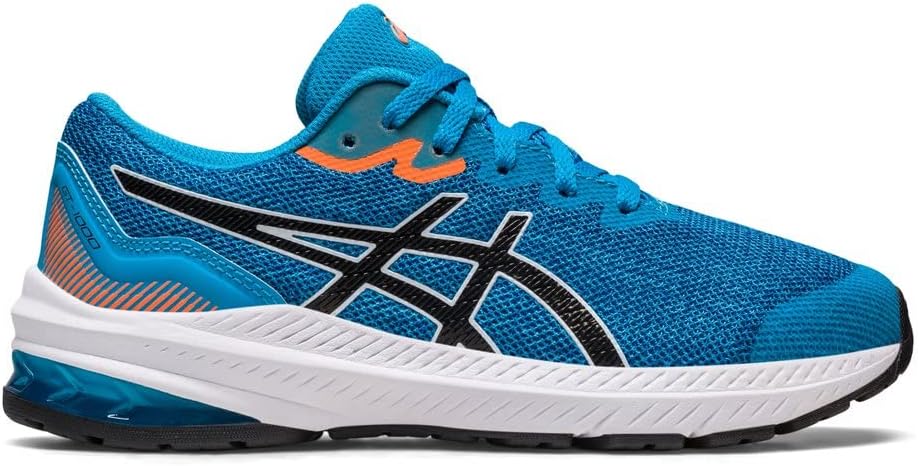
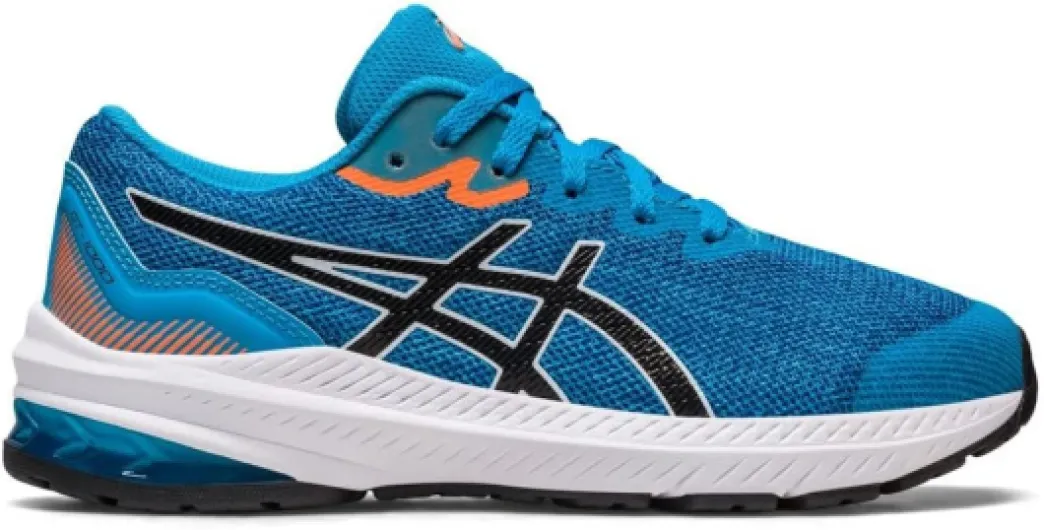
Design-wise, the GT-1000 11 GS sticks to ASICS’ usual running shoe language: a low-top silhouette, clear paneling, and the brand’s logo overlay on the sides. The colour here is “Island Blue Black”, which means a dominant blue upper with black accents. According to the Amazon classification, the pattern is “Solid”, so you’re not looking at flashy prints or wild gradients. It’s more of a clean, sporty look that fits both school sports and casual wear.
The overall style name is simply “Sneaker”, but everything from the shape of the sole to the mesh upper screams running shoe. The round toe and “No Heel” heel type (flat, no separate heel block) give it a more neutral stance, which is usually easier for kids to handle than shoes with aggressive heel drops or pointy toes. The low profile around the ankle should make it easy to pair with school uniforms or regular jeans without looking like a specialised racing spike.
One practical point: the shoe is specified as machine washable in the care instructions. For kids’ gear, that’s a big deal. Parents in the reviews don’t go into long detail about washing, but the fact that the manufacturer officially mentions machine wash suggests the materials and construction are built to handle occasional cycles. That makes the bright blue colour less of a concern, since mud and dust are part of the package with active kids.
In my opinion, the design is functional and sports-oriented, not fashion-forward. If someone wants a trendy chunky sneaker or a streetwear look, this is probably not it. But if the goal is a shoe that looks clearly like a running trainer, fits under the radar at school, and doesn’t clash with most outfits, the GT-1000 11 GS hits that straightforward, practical zone. It’s more about doing the job on the track and playground than making a style statement.
Comfort and support: what parents report
On comfort, the spec sheet is pretty clear: Maximum cushioning, GEL in the heel, a cushioned foam insole, and FlyteFoam midsole. All these elements point towards a shoe designed to soften impact for kids who run, jump, and move a lot. The elaborate mesh upper is said to adapt to the natural shape of the foot, and there’s an integrated support system to improve heel lockdown and give a feeling of security. On paper, that combination should feel more supportive than flat fashion trainers, especially during sports.
The published Amazon reviews are all positive and give 5/5 stars. Parents mention that the shoes fit as expected, matching the “Fit to Size Sentiment: Positive” line in the specs. This suggests that sizing is relatively consistent with usual UK kids’ sizes, which is often a pain point with other brands. Comments also hint that kids find them comfortable for daily wear and sporting activities, without early complaints of rubbing or pain. With only three reviews, you have to stay cautious, but there is no sign of recurrent issues like narrow toe boxes or hard heel counters.
The DuoMax support system is a key part of comfort for kids who slightly overpronate. By reducing excessive inward rolling, it can help feet and ankles feel more stable, especially on longer runs or repeated impacts during PE classes. Some children might not need that level of structure, but for those who do, having it integrated into a cushioned package is a solid point. The 2 cm platform height suggests a moderate stack that should keep the foot reasonably close to the ground, which can help with stability and confidence.
In my opinion, if a child mainly does light walking and casual wear, the full support package might be more than necessary, but it won’t hurt. For kids who run regularly, do athletics, or tend to come home with sore feet in basic trainers, this kind of construction makes sense. The only clear limitation is the lack of water resistance, which means comfort will drop quickly in wet conditions. For dry weather and indoor sports, though, the comfort and support package looks like a strong selling point.

Mesh, synthetic upper and rubber sole: built like a real runner
The materials are classic for a modern running shoe. The upper is synthetic with a mesh base, described as an “elaborate jersey” that adapts to the natural shape of the foot. That usually means a knitted or engineered mesh that’s more structured than simple textile, with zones of support and zones of ventilation. For kids, that can help balance breathability and foot hold, especially around the midfoot where the description says it offers “mesopiede support”.
The midsole/intersole uses FlyteFoam, ASICS’ proprietary lightweight foam. Paired with a GEL layer in the heel, the setup aims at both cushioning and a bit of responsiveness. On paper, that’s more advanced than the basic EVA slabs you’ll find in many generic kids’ trainers. The insole itself is foam with GEL cushioning, which should add another layer of impact protection between the foot and the midsole.
Underneath, the sole material is rubber, which is standard and sensible. Rubber outsoles generally handle abrasion from asphalt, playground concrete, and gym floors better than foam-exposed soles. The DuoMax support system is integrated on the medial side as a denser foam block. That’s not a separate piece of plastic; it’s still foam, just firmer to control overpronation. Structurally, this is very similar to adult stability running shoes, just scaled down.
From the few published reviews, buyers don’t complain about cheap materials or early peeling, which is a good sign, even if the sample size is tiny. In my opinion, for a kids’ shoe, the material choice is clearly performance-oriented rather than cost-cut to the bone. It’s closer to a scaled-down adult running shoe than a typical budget school trainer. That said, it’s still synthetic and mesh, so it’s not made for winter rain or deep puddles, and it’s not marketed as water resistant at all.
Durability and daily use potential
Durability is always a big question with kids’ shoes, and the GT-1000 11 GS has a few elements in its favour. The rubber outsole is a good starting point: rubber generally wears better than exposed foam on playgrounds, pavements, and indoor floors. The synthetic upper with mesh should resist tearing better than pure fabric, especially with overlays placed in higher-stress zones. The integrated support and heel counter also help the shoe keep its shape over time instead of collapsing inward.
The shoe is made in Vietnam, which is a common production location for many big running brands, and usually indicates a standard industrial process rather than ultra-budget manufacturing. The fact that the shoe is machine washable is another indirect sign of durability: ASICS wouldn’t recommend that if the glue and stitching failed immediately after a wash or two. For parents, being able to throw kids’ running shoes in the machine after muddy sessions is a practical plus and can extend the usable life simply by keeping them cleaner.
In the Amazon reviews, there are no early reports of sole separation, holes in the mesh, or dramatic wear after a short period. One buyer describes the shoe as ideal for a very active child and notes that it still looks and performs well after regular use. That doesn’t guarantee long-term durability for every kid, but it’s at least a positive early signal. With only three reviews, you can’t call it bulletproof, but there’s no red flag either.
In my opinion, the GT-1000 11 GS should handle a school year of normal sports and daily wear for most kids, assuming the size still fits. Very heavy toe draggers or kids who destroy every shoe in months might still wear them down quickly, but that’s more about usage than product design. If durability is the absolute top priority, some parents might look for models with reinforced toe caps or thicker outsoles. For a balanced package of performance and lifespan, though, this model looks reasonable and in line with what you’d expect from a brand-name running shoe.

Running performance and support for active kids
In terms of performance, the GT-1000 11 GS is clearly tuned as a stability running shoe for children. The DuoMax medial post, GEL heel, and FlyteFoam midsole are features that usually show up on adult shoes built for regular training. For kids doing school cross-country, club athletics, or just constant running at recess, this setup should, on paper, provide better impact protection and gait control than basic sneakers.
The GEL in the heel focuses on absorbing landing shocks, which is especially useful for heel strikers. FlyteFoam tends to be lighter than standard EVA, so the shoe should avoid becoming a heavy brick even with the added support. The rubber outsole is built for traction and durability on typical surfaces: school yards, pavements, and sports fields. The low-top design gives full ankle mobility, which is preferable for running and multi-directional play compared with mid- or high-top basketball-style shoes.
The published reviews, even though few, are fully positive. Parents highlight that their kids are happy wearing them for sports and that the shoes hold up fine for their intended use. There are no mentions of slipping, poor grip, or instability, which are common complaints when a running shoe design misses the mark. The fact that they’re described as suitable for both racing and daily running suggests they’re more of an all-rounder than a specialised competition spike.
In my opinion, performance-wise, the GT-1000 11 GS is a solid daily trainer for kids with a bit of pronation control. It’s not a minimal shoe, and it’s not an ultra-light racing flat, so if a child is doing only short sprints, it might be more shoe than needed. But for a mix of PE classes, running, and general active play, the balance of cushioning, stability, and traction looks well thought-out. There are faster shoes out there, and there are cheaper shoes out there, but few kids’ models combine this level of support with a true running DNA.
What the GT-1000 11 GS actually offers
The GT-1000 11 GS is a unisex kids’ sneaker built as a running and racing shoe. The official use cases are listed as “Racing, Running” and “Sports”, with an “Athletic Shoe” type and “Outdoor” lifestyle. So the intent is clear: this isn’t a lifestyle-only model. The cushioning level is marked as Maximum, with a foam insole that also integrates GEL, plus a FlyteFoam midsole. For a children’s shoe, that’s a fairly serious package in terms of shock absorption and support.
There’s a DuoMax support system on the medial side of the midsole, which is basically a denser foam wedge meant to reduce excessive inward rolling of the foot (overpronation). That’s usually marketed for adult runners, but here it’s brought down to GS (Grade School) sizing. For kids who have a tendency to roll inwards or who log a lot of kilometres in sports, this kind of structure can be a real plus on paper.
The shoe height is a low top with an ankle-strap mention in the spec (more about the adjustability than a true strap-based closure), and the closure is classic lace-up. The platform height is listed as 2 centimetres, so not a huge stack like some modern max-cushion shoes, but enough to house the foam and GEL system. The sole is rubber, the upper is synthetic with mesh, and the insole is foam. Weight isn’t specified, but given the materials it should be reasonably light for a stability-focused kids’ runner.
In terms of positioning, the GT-1000 11 GS sits as a supportive daily trainer for children rather than a minimal or ultra-fast race flat. The Best Sellers Rank (around 922 in Boys’ Fashion Trainers) shows it’s not a mass-market hit, but more of a targeted choice for parents who actively look for cushioning and stability. In my opinion, the spec sheet leans more towards protection and support than style trends or ultra-light performance.
Pros
- Maximum cushioning with GEL heel and FlyteFoam midsole for impact protection
- DuoMax support system offers real stability help for kids who overpronate
- Machine washable synthetic/mesh construction and rubber outsole suited to active daily use
Cons
- Not water resistant, limiting use in wet or winter conditions
- Support and price level may be unnecessary for kids with very light or occasional activity
Conclusion
Analysis score
The ASICS GT-1000 11 GS is a proper running shoe scaled down for kids, not just a casual trainer with sporty looks. With GEL in the heel, a FlyteFoam midsole, and the DuoMax support system, it targets children who run regularly, do school sports, or need a bit of extra stability due to mild overpronation. The mesh and synthetic upper, rubber outsole, and machine-washable construction round out a package that’s clearly built for everyday athletic use. The early feedback from buyers is very positive, with a 5/5 rating across the first three reviews and comments pointing to comfort and fit as strong points.
It’s not a perfect match for everyone. The shoe isn’t water resistant, so it’s more of a spring/summer and indoor sports option than a winter all-rounder. The support and cushioning package is probably more than necessary for kids who only wear trainers for short walks or occasional PE classes. And, as a branded running model, it will usually cost more than basic fashion sneakers. But for parents looking for solid protection for active, growing feet, the GT-1000 11 GS stands out as a serious, performance-oriented choice rather than a decorative kids’ shoe.
In my opinion, this model suits: kids who run a lot, children in athletics or regular PE, and those who need extra support due to rolling inwards. Families focused mainly on style, ultra-low price, or waterproof winter footwear should look elsewhere. Overall, as a kids’ stability runner with real tech under the hood, it delivers a convincing package.